
Day 35 - Research keeps goin'
A lot of work to do kept me away from the net last days. After four weeks in Berkeley, it’s time to take stock of the situation and summing up what I have done so far.
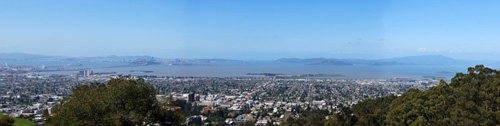
UC Berkeley Campus and San Francisco in the background from the Lawrence Hall of Science.
Just like in most of northern European countries, U.S.A. and Canada raised a significant awareness of Building Information Modeling and Integrated Project Delivery, making the most of them all over the entire building process. Considering literature on digital models in architecture, many American firms have changed their working practices, methods, and behaviors to better support their clients. I found several case studies books on these topics in Berkeley's libraries.
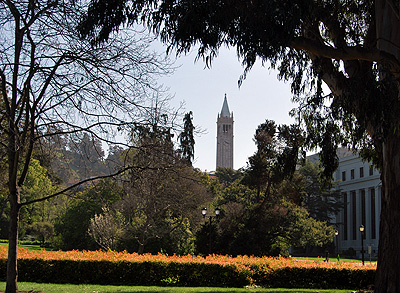
UC Berkeley officially declared springtime!
Quoting Finith Jernigan for example (author of Big BIM, Little BIM), “BIM includes processes by which the right information is made available to the right person at the right time”, through a visual framework “to represent physical and functional characteristics of an asset digitally in a reliable archive of asset information, from conception onward”.
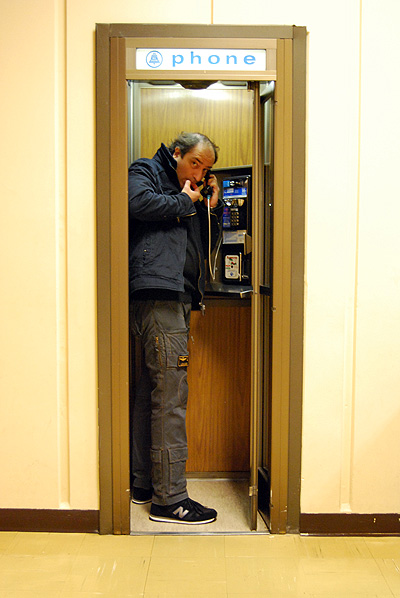
Me whistling a 2600Hz tone in a public phone (this is for connoisseurs :) ).
I found extremely interesting this point and a cross reference implication which the author points out between Buckminster Fuller’s work and BIM: Fuller’s Operating Manual for Spaceship Earth, written in 1969, can be actually considered a precursor of the whole BIM-based philosophy.
Fuller was responsible for many of today’s concepts in sustainability and in this book he examines how can man survive on Earth taking advantage of “Comprehensive Anticipatory Design Science”, able to “do more with less”, overlapping different specialties and disciplines through technology (hey guys, this is BIM!).
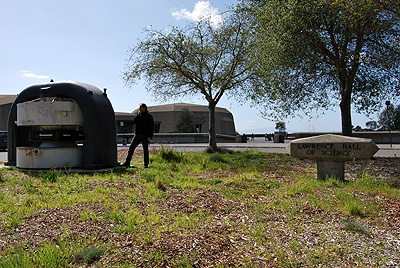
Me and a gigantic magnet used by Lawrence to build the first cyclotron up.
This way, technology becomes not only a software application but a holistic information based system as well, which builds long-term value and advances innovation, improving architecture and design, together with environment preservation and how people live.
2016 update here: this amazing page is full of works, pictures and info about Bucky Fuller. It's worth to pay a visit.
During last weeks I wrote a couple of scientific papers on this, and I’m planning to write a couple more before coming back to Italy. Here in the U.S., Building Information Modeling is tightly bound to sustainability, as I experimented and discussed with my fiancée and colleague Luisa Bravo.
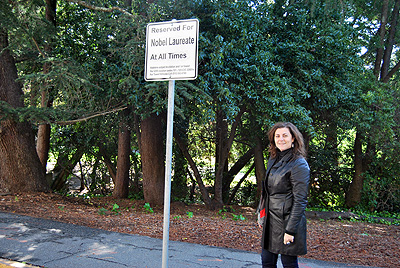
Standing on the shoulders of giants: Luisa and a parking destined to Nobel Laureate.
And here comes the point.
In my University I heard many “so-called professors” (I mean, unimpressive professionals completely avulsed from the academic tenure track, but enrolled for tuition in some university courses with temporary contracts) often talking about ‘sustainability’ to our students, ignoring the actual meaning of the word and confusing them with the-same-old-blah-blah about thermal performances, green certification and other similar trivialities, as if these elements were the one and only frontier of sustainability.
Eddy Krygiel and Bradley Nies (authors of Green BIM - Successful sustainable design with Building Information Modeling) mention the World Commission on the Environment and Development (also known as the Brundtland Commission) as a promoter of the best definition of sustainability: “Sustainable development meets the needs of the present without compromising the ability of future generations to meet their own needs”. This 1987 report to UN, published as "Our Common Future", deals with sustainable development and the change of politics needed for achieving that change. Once again, we can find here a lot of the elements today related to BIM: lifecycle, coordination policy, resources optimization, better quality in building design process and so forth. BIM is sustainable by definition.
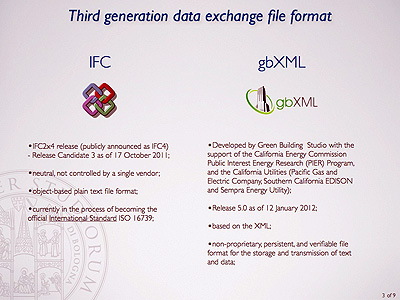
A slide from my weekly briefing at EECS: third generation data exchange formats specs in AEC.
Now, this out of a book story has been a good preamble to my work at UC Berkeley.
What I am trying to do is preparing a pipeline where geometric morphologies acquired by active and passive survey devices can be directly streamlined to analysis software (i.e. EnergyPlus). It’s the pathway to sustainability through a BIM approach, based on existing buildings explored by means of digital models.
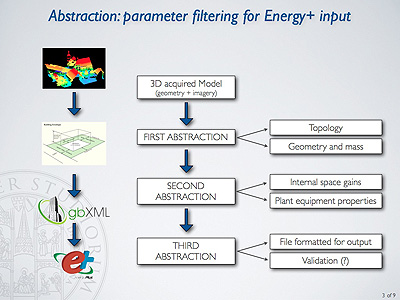
Another slide from my weekly briefing at EECS: my proposition to streamline data from pointclouds to thermal analysis.
As I already discussed, it’s a matter of abstraction and communication rules. That’s why I decided to abandon IFC format to delve much more into gbXML; I found this interchange language versatile and mature. Like IFC it belongs to the third generation of building descriptive formats and it’s modular, so only needed parameters can be included (this is important for existing buildings). The next move: gbXML translation into .idf for EnergyPlus streamline.
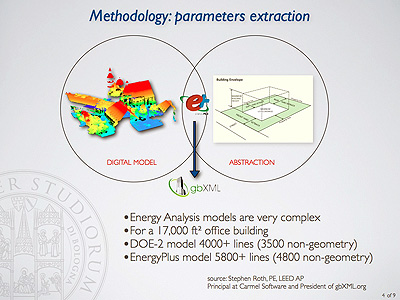
gbXML can be the language to express knowledge as the intersection of different information.
Embedding data properly into geometry is the fundamental of BIM.
As far as I can publish here, I'm now working on gbXML to isolate parameters in this modular way, searching for an optimization for data transfer towards the widest panoramas of BIM-related software.
Un commento

Info
Hai mai cercato un posto dove architettura, cultura geek e hardware vintage si incontrano davvero? Dal 2004 questo spazio è il laboratorio digitale di Simone Garagnani: qui si sperimentano idee, si collezionano storie nerd, si parla da tempo immemore di soluzioni BIM, rilievi digitali, computer graphics e retrocomputing. Ma non è nato tutto da solo: alle origini, fra i banchi universitari, c’erano anche Pasquale Squillace e Giuseppe Pernigotti. Da quei giorni, il blog è diventato una calamita per chi vuole sporcarsi le mani tra tecnologie d’epoca, cultura underground, digitalizzazione avanzata e creatività architettonica. Se ami la contaminazione tra passato, innovazione e un pizzico di ironia nerd, sei nel posto giusto.
Since 2004, this blog has been Simone Garagnani's digital playground - where geek culture, science, architecture, engineering ITs and vintage hardware come together. Here you can find hands-on experiments with retrocomputing, stories about underground nerd culture, and in-depth explorations of BIM, high-resolution digital surveying, and computer graphics for architecture, engineering, and construction. The blog was originally launched during my university years together with Pasquale Squillace and Giuseppe Pernigotti. Over time, it has grown into a hub for anyone interested in crossing wires between technology, creative design, and the hidden treasures of digital heritage. If you're passionate about mixing past innovations with new digital adventures, and enjoy a good dose of nerd irony, welcome, you'll feel right at home!
Segui le attività in TC Project: Registrazione
Follow TC Project activities: Registration/login
GreenSpider
 |
GreenSpider plug-in for Autodesk Revit |
Simone's World
TC Project home
Simone Garagnani's UniUrb's homepage
Imaging for Humanities Lab
Simone Garagnani's BIM Foundation
Associazione City Space Architecture
The Journal of Public Space
City Space Architecture Community
Public Space Academy
Architecture & Friends
Luisa BravoBravoDesign
kill-9
Ultimi commenti
SiliconSimon (VIC-20 The friend…): Thanks for the feedback Trevor, even though my reply comes so late! :)Petr (Faro Scenect and …): Hello. I have a Kinect XBOX360. I installed Scenect (scenect_5.2.100.32597_wma nual_x64_setup) on my c…
Ray Randolph (Cray-1 - The home…): One of two machines on my bucket list to make on my laser cutter. The second is an Enigma machine. C…
Trevor Dwyer (VIC-20 The friend…): Hi there, I feel your pain on updates and the internet not being the same these days – well since 199…
SiliconSimon (Cray-1 - The home…): If someone is interested in my little Cray’s files, please PM me since I do not often read comments o…
Robert (Cray-1 - The home…): If it’s possible, I would love to get the files from you for this project. I have a Cray-1 chip sitti…
Tagcloud
Meta


Thanks for the whistle! Much appreciated :D
Guido (E-mail ) (URL) - 15-04-’12 12:06