
Cray-1 - The home supercomputer
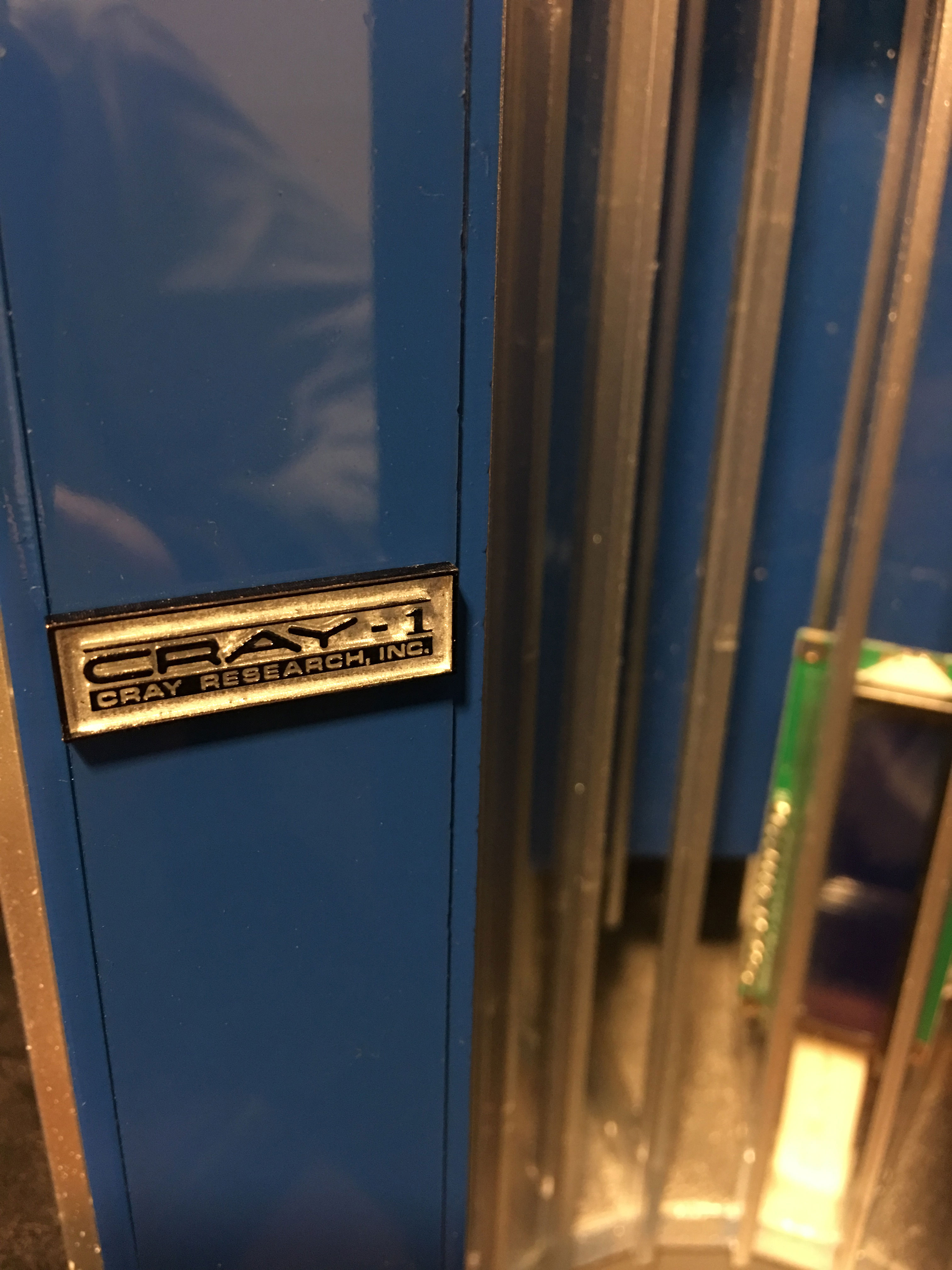 It took me almost a year to complete the Cray-1 project during my spare time. When I decided to build a physical copy of the first supercomputer ever, as faithful as possible, I found on the web a lot of inspiring examples (just like this one by Chris Fenton). In 1975 the 80 MHz Cray-1A was announced. Excitement was so high that a bidding war for the first machine broke out between Lawrence Livermore National Laboratory and Los Alamos National Laboratory, the latter eventually winning and receiving serial number 001 in 1976 for a six-month trial. Since then, the Cray-1 supercomputer reigned as the world’s fastest from 1976 to 1982 (source).
My personal 1:8 Cray-1A was made laser cutting some plexiglass sheets after a careful drafting process of the main vertical framework, which originally hosted over 60 miles of wire with no segment longer than 3 inches, to minimize signal delays. Amazing! My Cray-1A is equipped with a Rasperry Pi 2 board (out of 12 possible parallel slots) running a customized Os: a dedicated I2C controller drives a 16x2 characters LCD blue display while wi-fi and bluetooth interfaces guarantee wireless connections.
Info
Dal 2004 questo piccolo angolo di rete raccoglie gli interessi di ricerca e i lavori di sperimentazione digitale di Simone Garagnani in materia di cultura geek, ma soprattutto di Building Information Modeling, rilievi digitali ad alta risoluzione e computer graphics legata al mondo dell'architettura, dell'ingegneria e delle costruzioni. TC Project, è presente anche sul social network Facebook.
Welcome to these pages that host since 2004 Simone Garagnani's personal blog, a collection of nerd notes and geek experiences focused sometimes on Building Information Modeling, terrestrial laser scanning, digital photogrammetry and computer graphics applied to the AEC world. The TC Project is also available on Facebook.
Segui le attività in TC Project: Registrazione
Follow TC Project activities: Registration/login
GreenSpider
 |
GreenSpider plug-in for Autodesk Revit |
Ultimi commenti
Trevor Dwyer (VIC-20 The friend…): Hi there, I feel your pain on updates and the internet not being the same these days – well since 199…SiliconSimon (Cray-1 - The home…): If someone is interested in my little Cray’s files, please PM me since I do not often read comments o…
SiliconSimon (Cray-1 - The home…): Of course Mike, I sent you a PM!
Robert (Cray-1 - The home…): If it’s possible, I would love to get the files from you for this project. I have a Cray-1 chip sitti…
Mike (Cray-1 - The home…): Are the files still available?
MojaMonkey (SGI VW540 @ TC La…): Hi Simon? This is a long shot but I was wondering if you have a copy of the SGI drivers required to…
Tagcloud
Error opening fileCould not lock /web/htdocs/www.tcproject.net/home/pivotx/pivotx/db/ser_tags.php for writing!
Try logging in with your ftp-client and check to see if it is chmodded to be readable by the webuser (ie: 777 or 766, depending on the setup of your server).
Current path: /web/htdocs/www.tcproject.net/home/pivotx/pivotx.