
Day 22 - It's all a matter of abstraction
This has been a very long week at the campus, and it’s not finished yet. Briefing with the “indoor modeling”@EECS guys last Tuesday was illuminating. I think I’m starting to be part of UC Berkeley philosophy in its intimate essence: to look into things deeply and figure how they work out, without preconceptions. Guys are working on amazing themes...
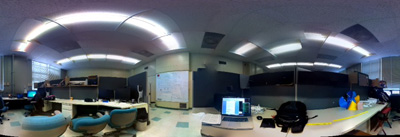
My desk in room 307, Cory Hall.
Here I can really touch how the "magic of scan" happens, hearing from guys how it’s hard coding sift or ransac algorithms, or how scanners can be set up to obtain a better cloud superimposition and in less time.
It’s so inspiring, even if I’m not a code monkey and even if I cannot give them much more than some impressions as a power user of survey technology.
Let’s come to my research. My “Chinese box theory” has been some kind of utopism since I imagined it, even more if applied to existing historical buildings. Well, things could change in a few time: extracting features from point clouds is a dream no more, relating elements to each other in a BIM process could then lead to a unified digital model, embedding abstractions for different actors’ purposes. That’s what I’m trying to study here.
Yesterday I was invited to a lunch conference held by Prof. Hyeun Jun (Honjun) Moon, visiting scholar at Lawrence Berkeley National Laboratory, Professor at Dankook University in Korea. Topic was “Energy Efficient Design in Early Design Stages using BIM technologies”. After addressing well known issues about interoperability in BIM processes (taking advantage of IFC and gbXML file formats), Prof. Moon talked about how engineering buildings, beginning with Rhino+Grasshopper geometries to optimize their parameter through EcoTect and Energy+ analysis.
His software, aimed to display gbXML data, sounds great! The first of that kind I’ve ever seen.
Unfortunately, the pathway that leads to a unique model for all is still very segmented and not seamless. Things become way more complicated with format conversions, which are not lossless: that's why I think it's all a matter of abstraction. I mean, if you have a digital model, what sort of parameters do you wish to isolate and transmit to make your model useful to simulation software? I think IFC and gbXML, a starting point for the answer, are the top of an iceberg that involves how to communicate knowledge (in scientific literature I found some connections with BKM, Building Knowledge Modeling).
Abstraction is the issue and we have to figure it out!
Curiosity is the way, mainly here in a land where creative thinking lies in the detail.
Info
Dal 2004 questo piccolo angolo di rete raccoglie gli interessi di ricerca e i lavori di sperimentazione digitale di Simone Garagnani in materia di cultura geek, ma soprattutto di Building Information Modeling, rilievi digitali ad alta risoluzione e computer graphics legata al mondo dell'architettura, dell'ingegneria e delle costruzioni. TC Project, è presente anche sul social network Facebook.
Welcome to these pages that host since 2004 Simone Garagnani's personal blog, a collection of nerd notes and geek experiences focused sometimes on Building Information Modeling, terrestrial laser scanning, digital photogrammetry and computer graphics applied to the AEC world. The TC Project is also available on Facebook.
Segui le attività in TC Project: Registrazione
Follow TC Project activities: Registration/login
GreenSpider
 |
GreenSpider plug-in for Autodesk Revit |
Ultimi commenti
Trevor Dwyer (VIC-20 The friend…): Hi there, I feel your pain on updates and the internet not being the same these days – well since 199…SiliconSimon (Cray-1 - The home…): If someone is interested in my little Cray’s files, please PM me since I do not often read comments o…
SiliconSimon (Cray-1 - The home…): Of course Mike, I sent you a PM!
Robert (Cray-1 - The home…): If it’s possible, I would love to get the files from you for this project. I have a Cray-1 chip sitti…
Mike (Cray-1 - The home…): Are the files still available?
MojaMonkey (SGI VW540 @ TC La…): Hi Simon? This is a long shot but I was wondering if you have a copy of the SGI drivers required to…
Tagcloud
Meta


